
“Artificial intelligence is changing the way scientific research is conducted, and is also forcing us to rethink the future of education and science communication,” Guo Zhe, Executive Vice President of the China Association of Natural Science Museums (CANSM) and Director General of the China Science and Technology Museum, said at the opening ceremony of the 2026 Beijing International Science Communication Exchange Week in Beijing on Wednesday.
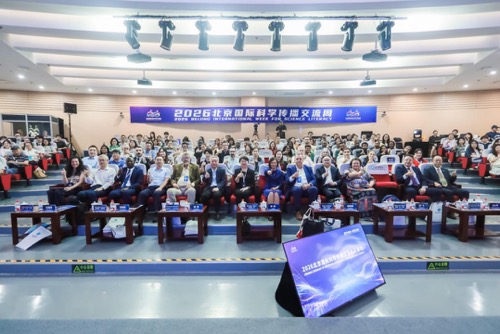
Running from September 22 to 26 at the Beijing Science Center, the exchange week’s science education exhibition, themed “Working Together for Common Development,” brings together institutions from China and overseas.
Exhibits invite visitors to explore the quantum world, revisit the ancient Persian tradition of stargazing and discover ingenious ancient Greek technologies. Visitors can also get hands-on with science experiments and try a range of cutting-edge AI applications, among other exhibits brought by science museums and science centers from different countries.
Most exhibitors have also prepared interactive activities, allowing visitors to explore scientific knowledge through experiments and hands-on experiences. The shift toward more interactive forms of science communication comes as AI and interdisciplinary innovation are rapidly changing the way science itself develops.
As AI becomes increasingly embedded in scientific research, Guo noted that science communication should go beyond simply presenting established knowledge and help the public understand how science is evolving and how innovation takes place.
Four institutions joined the Beijing Global Network of Science Festival (BGNSF) Online Salon as new members: the Gökmen Space & Aviation Training Center (GUHEM), Zimbabwe Science Fair, Guangxi Science & Technology Museum and Shenzhen Science & Tec hnology Museum.
The Beijing Science Center also signed a cooperation agreement with the Ancient Greek Technology Museum | Kotsanas Museum on Wednesday. The agreement was signed by Tang Jin, director of the Beijing Science Center, and Panagiotis Kotsanas, co-founder and director of touring exhibitions at the Kotsanas Museum of Ancient Greek Technology.
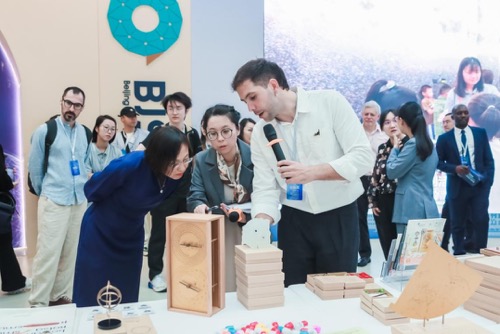
The international exchange continues in the exhibition area, where science education content from different countries and periods is presented through interactive displays and hands-on activities.