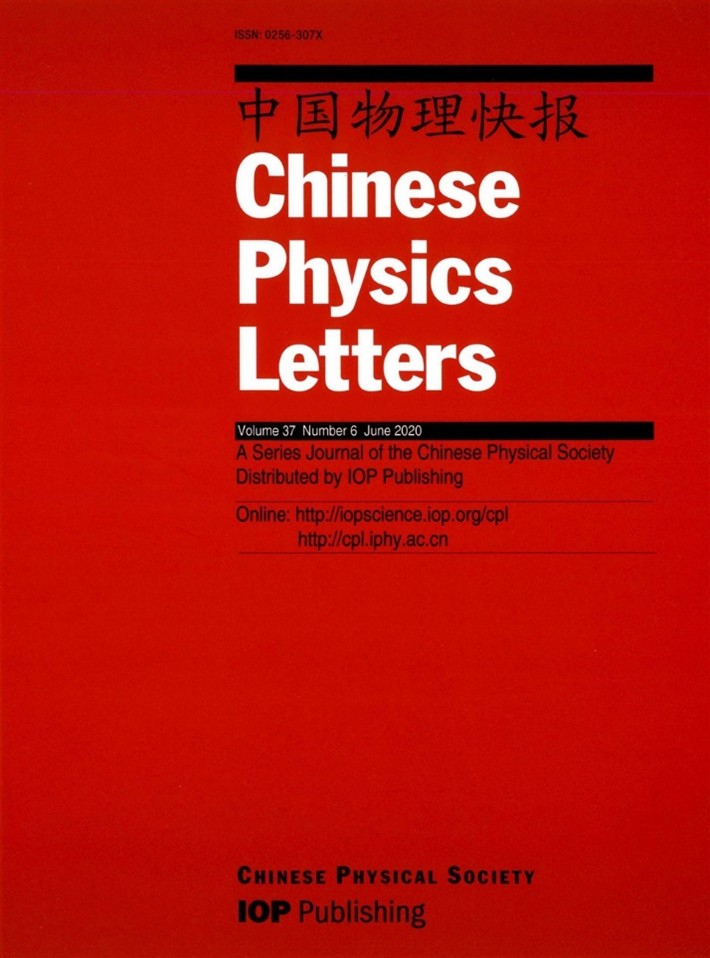
A cover of the journal Chinese Physics Letters. [File photo]
Chinese Physics Letters (CPL), the English-language flagship journal of the Chinese Physical Society, is celebrating four decades as a leading platform showcasing China's achievements in physics to the world. Since its launch in 1984, the journal has become both a window through which international scholars observe the rise of Chinese physics and a faithful record of the discipline's steady ascent to the global frontier.
A bridge to the world and a voice for Chinese physics
Since its founding, CPL has carried the expectations of senior Chinese physicists who envisioned a journal capable of connecting China's scientific community with the international academic landscape. Nobel laureates Yang Chen-Ning and Tsung-Dao Lee were invited to serve as advisory members of the editorial board, offering insightful guidance and helping establish a high starting point for the young journal.
Throughout his career, Professor Yang published seven influential papers in CPL, a gesture that reflected the commitment of the older generation of scientists to elevate China's international standing in physics. His contributions also set an example for younger researchers dedicated to academic excellence and service to the nation.
Over the years, CPL has published a series of landmark discoveries representing the highest level of Chinese physics research. In 2008, a team led by Zhao Zhongxian, academician of the Chinese Academy of Sciences (CAS), raised the critical temperature of iron-based superconductors to 55 K, a record that still stands today. He chose CPL for the first publication of this groundbreaking work, which soon gained global recognition and was named one of the Science journal's Top Ten Sci-tech Breakthroughs of the Year. The discovery later contributed to Zhao's receipt of the first prize in China's State Natural Science Award (2013), the National Highest Science and Technology Award (2016) and the Future Science Prize (2023).
CPL also published CAS academician Xue Qikun's pioneering 2012 breakthrough in interface high-temperature superconductivity, a milestone that opened a new direction globally and supported his later winning of the Future Science Prize (2016) and the National Highest Science and Technology Award (2023).
Strengthening academic quality and expanding international impact
Since 2012, CPL has received support from national programs for enhancing the international impact of China's science and technology journals, enabling rapid development. Editorial board members play a crucial role by screening submissions, ensuring academic rigor and overseeing fair and efficient review.
With rising publication quality, the journal's influence has expanded significantly — its impact factor has quadrupled over the past six years. In 2024 and 2025, CPL entered the JCR Q1 category and the Zone 1 ranking of the CAS Journal Ranking, attracting higher-quality submissions and achieving growth in both manuscripts received and papers published.
CPL also hosts the annual Chinese Physics Journals Session at the Chinese Physical Society Fall Meeting, together with the journals Physics, Acta Physica Sinica and Chinese Physics B. The event now brings together more than 20 domestic journals and has become an important platform for scholarly exchange. The four journals also jointly organize an academic lecture series titled "Yi Lu You Li" (Physics Along the Way), which interprets the Nobel Prize in Physics and highlights academic frontiers, drawing up to 100,000 online viewers per session.
Launching high-impact columns and supporting breakthrough discoveries
To accelerate the publication of top-tier research, CPL launched a column titled Express Letters in 2012 under the leadership of then-editor-in-chief Zhu Bangfen, a CAS academician. The section rapidly gained recognition for its role in protecting the international priority of major Chinese discoveries.
A notable example came in 2019, when the team led by He Ke, Xue Qikun and Xu Yong at Tsinghua University reported the experimental discovery of the intrinsic magnetic topological insulator MnBi2Te4. Submitted to CPL in May, the paper was swiftly published in Express Letters. Later that year, Nature published similar results from an overseas group and specifically acknowledged the Tsinghua team's contribution — a testament to both China's research strength and CPL's role in timely dissemination of major findings.
As editor-in-chief, I am proud of the journal's rapid growth, yet keenly aware of the responsibilities it entails. We will continue to uphold our principles of publishing high-level research and providing efficient, high-quality services. Guided by the philosophy of "relying on scientists and serving scientists," CPL will continue contributing to the advancement of Chinese physics and to China's strength in science and technology.
The article was originally written in Chinese by Xiang Tao, editor-in-chief of Chinese Physics Letters.